
Google presents Gemini 4 Carbon, the most advanced AI model but not yet accessible to everyone
Google presents Gemini 4 Carbon with better results in coding and security, but initial access is reserved for cyber defenders.
Google has announced Gemini 4 Carbon, an advanced AI model that follows Gemini 4 Argon just two weeks after its launch. The company reports progress in programming, autonomous activities of AI agents, scientific analysis and especially in cyber defense. Despite the results communicated, the model is not yet accessible to the general public: distribution will begin with cybersecurity professionals, while a precise date has not been indicated for developers, companies and consumers.
Gemini 4 Carbon improves coding and autonomous activities
The new model is presented as an evolution of the capabilities already offered by Argon, not as the expected Flash variant. As reported by 9to5Google, Google has worked on the feedback received after the previous launch to improve code production, agent task execution, scientific reasoning, full-stack web development and multimodal understanding.
The company attributes the speed of the release to collaboration between researchers and AI models during development work. Ars Technica notes, however, that Carbon outperforms Argon by limited margins in the tests presented and that, from the information available, it is not possible to establish whether it is an entirely new architecture or an update obtained through further training.
Cybersecurity and safer code generation
TheresafetyIT is one of the areas in which Google claims the most significant progress. Carbon achieves 88.2% on SEC-bench Pro for vulnerability discovery, 54.8% on ExploitGym for flaw exploitation activities, and 71.0% on CWE-bench for producing fixes. These are benchmark results reported by the company, not guarantees of effectiveness in any operating environment.
Compared to Argon, Carbon would be twice as likely to generate vulnerability-free code. The Chrome team also claims that the model produces high-quality patches with ten times better results than the non-Google models used in the comparison. However, the sources do not describe in detail the conditions of this latest evaluation, so the data should be read as a statement from the development group.
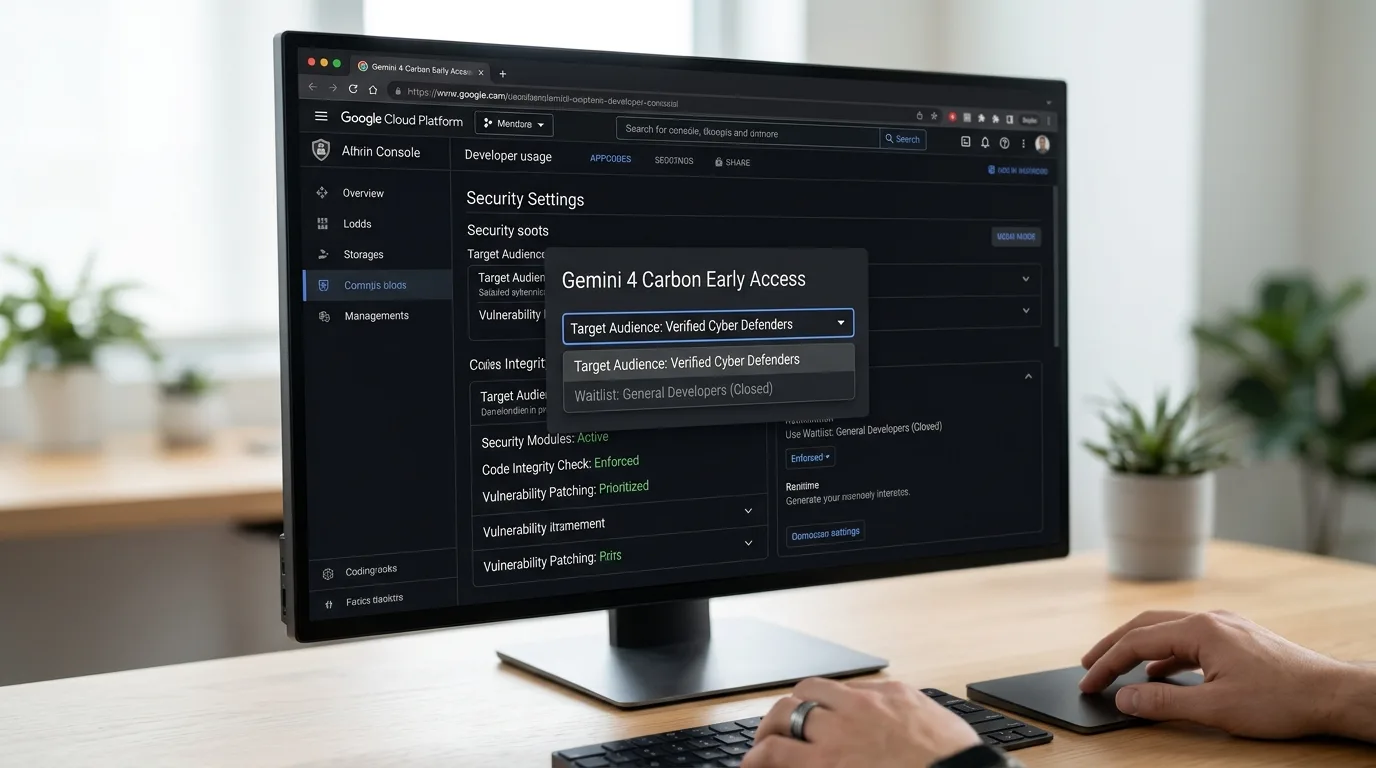
These capabilities also explain the choice of a conservative distribution. Google intends to make the model available to cyber defenders first, through the Fairwinds program and as part of an evaluation path linked to the US government's voluntary testing framework.
Benchmarks and comparisons with other AI models
Google gives Carbon first place in version 5.0 of the Artificial Analysis Intelligence Index, with a score of 59. In the WebDev Arena benchmark the model earns 89 Elo points, reaching 1769 and placing in fourth place.WebDev Arenait is one of the references cited to evaluate the quality of results in web development.
According to the analysis reported by Ars Technica, Carbon surpasses GPT-6 Astra, Claude Opus 5.5 and Claude Fable 5.1 in almost all tests illustrated by Google. The differences, however, are often limited to a few points: the results alone do not allow us to conclude that the model is superior in every concrete activity.
Security, reliability and error management
In addition to performance, Google claims to have strengthened security measures. In the Gray Swan evaluation, Carbon resisted all prompt injection attempts examined, recording 0% attack success. In the same comparison Argon recorded 0.7%, Claude Opus 5.5 1% and GPT-6 Astra 8.5%. The result concerns that specific evaluation and does not demonstrate the impossibility of attacking the model in other scenarios.
In internal tests reported by the company, unsupported claims are reduced by about two times compared to Argon. Google describes a more conservative behavior when evidence or authorization is missing: the model should point out methodological limitations, indicate what information is still needed, and highlight any discrepancies in the sources instead of completing uncertain steps on its own.
The company also reports a 26% reduction in interventions beyond the required limits and a 29% reduction in cases in which the model does not adequately complete the work. These are internal metrics that Google links to greater reliability in performing complex tasks and collaborating with users.
Phased availability and pricing of APIs
For developers, companies and consumers, Google speaks of an imminent arrival, without setting a general date. Ars Technica lists AI Ultra subscribers and developers using the Gemini API as possible next initial recipients, but this is not a confirmed timetable.
Access via API has an introductory price of $2 per million incoming tokens and $10 per million outgoing tokens. Input tokens retrieved from the cache will have a 95% discount compared to the regular input fee. Once the promotion ends, prices will rise to $4 and $20 per million tokens respectively.
Google hasn't said when Carbon's promotional period will end. The distinction is important: the tariffs have been announced, but the actual availability of the model and the duration of the discount remain subject to the phased distribution program.
Editorial source consulted:Ars Technica.


Commenti
Ancora nessun commento. Sii il primo a partecipare.