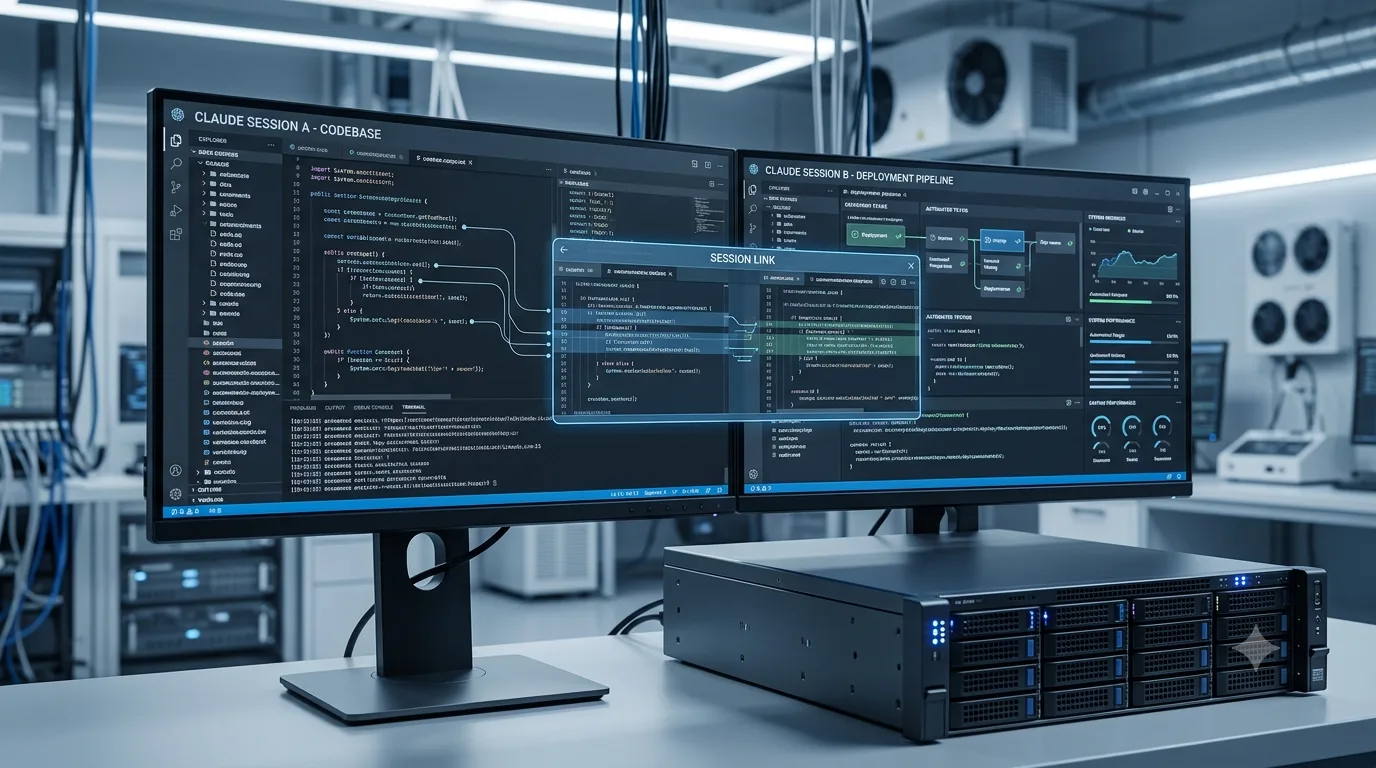
Anthropic's Claude Code: AI sessions now communicate with each other to improve collaboration
Anthropic improves on Claude Code by introducing linked sessions, allowing AIs to communicate with each other for more effective collaboration in
Claude Code linked sessions is at the center of the novelty: Anthropic introduces a significant evolution for its artificial intelligence model dedicated to programming, Claude Code. The new "linked sessions" functionality allows different instances of Claude Code to interact and exchange information while carrying out complex tasks. This innovation, as reported by HDBlog, aims to make AI an even more powerful and collaborative tool for developers, overcoming the limitations of single isolated sessions. The goal is to create a working environment where artificial intelligence can act in a more synergistic way, facilitating problem solving and code optimization.
Claude Code: AI sessions now communicate with each other
The main innovation introduced by Anthropic in Claude Code is the ability of AI sessions to communicate directly with each other. Traditionally, each session of an AI model operates independently, without being able to access or share information with other active sessions. With connected sessions, Claude Code can now maintain a shared context and exchange data and progress, simulating a form of collaboration between different artificial intelligences. This means that, for example, one instance of Claude Code could work on a specific module of a software, while another works on another aspect, and both can share results and discoveries to improve the overall work.
How linked sessions work
Claude Code's linked sessions are designed to facilitate complex development scenarios. Imagine having to debug a particularly difficult application: instead of having to manually copy and paste code snippets or error descriptions between different chat windows, linked sessions allow Claude Code to manage this workflow more smoothly. One instance might analyze an error log, while another tries to generate potential solutions based on that log. Information is exchanged intimereal, allowing AI to build a deeper understanding of the problem and propose more targeted and effective solutions. This collaborative AI approach promises to significantly speed up development cycles and improve the quality of product code.
Benefits for developers
Claude Code linked sessions - The benefits for developers are many. First, collaboration between AI sessions reduces the cognitive load and manual work required of humans. Second, the ability to maintain a shared context allows AI to address larger, interconnected problems that would be difficult for a single session to handle. This translates into faster development times, more efficient debugging, and potentially more robust and performant software. The ability to delegate complex tasks to a collaborative AI team opens new frontiers in software development automation.

The future of human-machine collaboration with AI
The introduction of linked sessions in Claude Code represents a significant step forward towards a future where artificial intelligence is not just a support tool, but a true collaborator. Anthropic is demonstrating how AI models can be designed to work together, amplifying their capabilities and delivering exponential added value. This evolution could lead to a redefinition of workflows in software development and other sectors, where the ability to coordinate and communicate between AI entities will become crucial to address increasingly complex challenges. The promise is that of deeper and more productive human-machine interaction.
Update on Claude Code's abilities
The linked sessions feature in Claude Code is a concrete example of how AI models are evolving from monolithic tools to interconnected ecosystems. This inter-AI communication capability opens up unprecedented scenarios for the automation and optimization of complex processes, laying the foundations for future innovations in the field of generative artificial intelligence.
Learn morehere


Commenti
Ancora nessun commento. Sii il primo a partecipare.