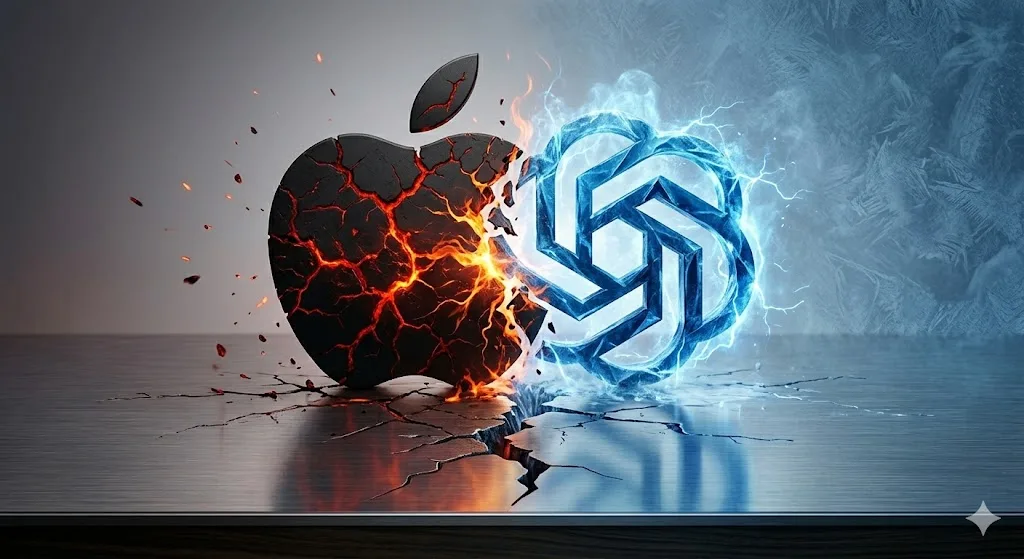
Apple and OpenAI heading for divorce? The AI partnership that was supposed to revolutionize Siri now risks ending up in court
The collaboration between Apple and OpenAI risks ending up in court. Find out the reasons, OpenAI's accusations and Apple's privacy concerns.
Apple and OpenAI heading for divorce? The AI partnership that was supposed to revolutionize Siri now risks ending up in court
Learn more:orion
From the enthusiasm of WWDC 2024 to legal tensions: why the agreement between Apple and OpenAI could break down and what would really change for iPhone users
When Apple announced its partnership with OpenAI during WWDC 2024, the message was very clear: Siri would finally make the leap in quality. After years of delays, jokes and merciless comparisons with Alexa and Google Assistant, Cupertino seemed ready to relaunch its AI ecosystem thanks to the integration of ChatGPT into iPhone, iPad and Mac.
For many Apple users it was a historic moment. Finally Siri could understand complex requests, generate texts, summarize documents and manage much more natural conversations. It seemed like the beginning of a new one and instead, almost two years later, what was supposed to be a strategic collaboration risks turning into a sensational legal clash.
According to Bloomberg, OpenAI is in fact considering legal action against Apple for alleged contractual violations and for economic results considered much lower than expectations. A situation that tells very well how delicate the artificial intelligence market has become, especially when two giants with completely different philosophies clash.
Apple OpenAI partnership: how the agreement was born
The Apple OpenAI partnership was officially born in June 2024, even if negotiations between the two companies had started months earlier. Bloomberg had already anticipated in April and May 2024 that Apple was in negotiations with both OpenAI and Google to integrate AI models into iOS 18.
Ultimately he chose ChatGPT.
The strategy was very simple: Apple would maintain control of user experience and privacy, while OpenAI would provide the “intelligent” part of the more advanced requests. In practice Siri would have acted as an intermediary. When necessary, some questions would be forwarded to ChatGPT.
During the WWDC keynote everything seemed perfect. Craig Federighi spoke of a Siri that was finally more useful, more contextual and more powerful. Sam Altman, CEO of OpenAI, publicly celebrated the agreement.
Behind the scenes, however, the situation was probably much less rosy than it appeared.
According to various rumors, the agreement did not include significant direct payments from Apple. Cupertino would have "repaid" OpenAI through the distribution and visibility guaranteed to ChatGPT within the iPhone ecosystem.
And this is exactly where the problem arose.
OpenAI accuses Apple: “ChatGPT is too hidden”
According to Bloomberg, OpenAI believes that Apple has severely limited the visibility of ChatGPT within iOS, iPadOS and macOS.
Yes, that's right: Siri can query ChatGPT. But in daily practice many users don't even know that this function exists.
And honestly, as a daily Apple user, I totally get the point. Current integration is almost invisible. Apple has built a system where the user perceives everything as “Siri”, while OpenAI remains in the background.
For the company this is a choice that is absolutely consistent with its philosophy. Apple wants to control the user experience from start to finish. He doesn't want an external service to become the protagonist inside the iPhone.
But from OpenAI's point of view the situation changes completely.
Sam Altman's company hoped the deal with Apple would bring billions of dollars in new ChatGPT Plus subscriptions and an explosion in global usage of the service. According to sources reported by Bloomberg, those results "didn't even come close" to initial expectations.
And this is why OpenAI is considering sending a formal notification for alleged breach of contract.
Does Apple Really Don't Trust OpenAI?
The interesting thing is that the tensions seem mutual.
Bloomberg claims that Apple also has several doubts about OpenAI, especially on the topic of privacy. And this is where a huge cultural clash emerges between the two companies.
Apple has built its brand around the protection of personal data. For years Tim Cook has been repeating that "privacy is a fundamental human right".
OpenAI, on the other hand, thrives on AI models trained on enormous quantities of data and a much more open and aggressive approach to innovation.
The company probably fears that any problems related to data management could damage the image of the iPhone.
And it is also for this reason that Apple has always avoided a total integration of ChatGPT into the operating system.
In fact, Siri today uses OpenAI almost as an "external engine", but maintaining a strong separation between the two worlds.
The secret project with Jony Ive that would have irritated Apple
Then there is another element that would have further worsened relations: OpenAI's AI hardware project together with Jony Ive.
And here the question becomes almost personal.
Jony Ive is not just any designer. He is literally one of the most important figures in Apple history. The man behind iPhone, iMac, iPad and much of modern identity.
Knowing that he is currently collaborating with Sam Altman on the creation of new AI devices would have irritated Apple a lot.
Why? Simple.
If OpenAI really manages to create a revolutionary new device based on artificial intelligence, it could become a direct competitor to the iPhone in the long term.
And it's clear that Apple has no intention of helping a potential rival grow too much within its ecosystem.
iOS 27 will change everything: Gemini and Claude arrive
In the meantime, Apple is already preparing "plan B".
According to the most recent rumors, with iOS 27 Cupertino will introduce a much more open system that will allow users to choose different AI models within Siri.
No longer just ChatGPT.
In fact, there is talk of the integration of Google Gemini and Claude by Anthropic as official alternatives.
A huge turning point.
In practice, Siri would become a sort of neutral platform capable of interfacing with multiple AI models simultaneously.
And looking at it from the outside, it clearly seems like a move designed to reduce dependence on OpenAI.
Apple wants to avoid finding itself in the same situation it experienced years ago with Google Search: a partner that has become too powerful and too indispensable.
Who really risks the most?
The real question is this.
Can Apple Afford to Lose OpenAI?
Probably yes.
Apple has enough economic resources to change partners, develop proprietary models or create a multi-AI ecosystem.
OpenAI, on the other hand, risks losing a gigantic showcase: over two billion active Apple devices in the world.
And this is precisely the central point of the story.
The Apple OpenAI partnership began as a win-win collaboration. Apple finally achieved competitive artificial intelligence without developing it from scratch. OpenAI gained access to the most profitable consumer ecosystem on the planet.
But today both seem to have understood that the other part could become too cumbersome.
And when it happens in the tech world, there is often only one ending: separation.
With all due respect to users who were finally hoping for a truly revolutionary Siri.


Commenti
Ancora nessun commento. Sii il primo a partecipare.